

Camerhogne, re-named Grenada by Spanish invaders, was lastingly occupied by European invaders from 1649.i Kalinago and Taino communities that populated the coastlines of the island repressed any attempts at European occupation from Columbus’ sighting in 1498 until French invaders broke through in 1649. What followed was the standard policy of colonial inhabitation: seize lands, wipe out or enslave its people, and install agricultural systems that take without giving back in return. It took a mere decade or so for the indigenous populations of Camahogne to be near exterminated by the European genocide. This strategy is the systematic foundation to colonisation. Grenada, as much of the rest of the Caribbean, is founded on the graveyards of indigenous peoples that were rendered near-extinct by European invasions.
Implementing the plantation system, where – to start – the French could steal the natural resources of Grenadian land for a maximum profit, relied on the trafficking of captive African populations across the Middle Passage. From 1669-1837, at least 141,341 captives were forcibly embarked on the West African coasts, disembarking 124,412 enslaved persons in ports in Grenada. While the trafficking of enslaved Africans in Grenada was launched by French colonisation, the demand for enslaved labour increased substantially once the British invaded and first took over colonising Grenada in 1763.
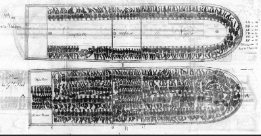 It only took a year (1763-64) for the British to carry out 1.5 times more voyages than the French, and in 2 years the British had overtaken the number of captives the French had trafficked to Grenada – in 1765 alone more captives were disembarked in Grenada than in 93 years of uninterrupted French colonisation.ii We need to specify ‘uninterrupted’ as there was a brief period in the late 1770s to early 1780s (1779-1784) where the French occupied Grenada before being forced out for uninterrupted re-occupation of the British.
This difference is quite clear not only in the frequency of ships but also in the distribution of plantation estates and crops primarily cultivated: French early colonisationiii preferred to parcel out smaller plantation units where enslaved populations laboured coffee, indigo, cotton, sugarcane cropsiv. By 1780, the majority of crops cultivated in Grenada was sugar, and that by 1810, 72% of Grenada’s 30,000 enslaved population was attached to sugar plantation estates.v
It could be interpreted when sugar took off in Grenada, from the time it took to clear the land, collapse plantation units into larger ones for widescale sugar plantations and require a higher supply of enslaved workforcevi: between 1765 and 1766, the number of enslaved Africans trafficked by the British jumped by 30%, remaining at an average of 5,275 trafficked a year over a decade. Between 1763-1779 (the first transition period btw British and French colonialism), maps with digitised plantation estate records indicate that units in every English-named parish of the island at least doubled, if not tripled in size in that time.vii
The effects on chattel enslavement are inscribed in the land in the blood of enslaved populations, whereby mortality rates were high, the conditions of enslaved labour were brutal, and enforced by dehumanising viciousness. The primary production of sugarcane itself required great industry. Literally. The technological equipment required to process sugar from sugarcane is substantial and requires a higher rate of enslaved persons to labour this crop.viii Thus, the rapid increase of trafficking once British colonisation was first attempted from 1763 until 1779: The British empire was notably interested in the high, quick profits that could be extracted from sugarcane.xi These are quick profits that are equally rapidly damaging to natural environments, demanding a massive clearance of natural ecosystems as well as degrading soil fertility in under 10 generations of crop yield. The widespread installation of sugarcane as a primary crop under the British, following the early colonisation of the French literally raped the land, at the cost of the lives and humanity of enslaved populations.
Resistance to this oppression predates the beginning of chattel enslavement in Grenada. As mentioned above, the indigenous people residing in Camahogne consistently fought back against successive waves of European invaders until well into the 1650s, when the Kalinago and Taino populations faced near-extinction at the hands of French brutality. Under the system of chattel enslavement, enslaved populations resisted fiercely, consistently fighting for freedom on their own terms in several ways. The most notable resistance movement in Grenada is known as Julien Fédon’s rebellion from 1795-1796.
Fédon was known and registered as a free coloured planter (who ‘owned’ enslaved persons). The life of Fédon himself as navigating these dynamics is particular to the Grenadian history of colonisation. It is a story that tells us of the complex relationships between class, racialisation and property ownership under the system of chattel enslavement.x
What is also clear is that Fédon’s rapid shift from enslaving to liberating can partly be understood from local and regional geopolitical shifts: the French briefly re-gained some form of sovereignty of Grenada in the 1770s-80s, which was just as quickly overtaken by British occupation from 1784. As well, the 1791 Revolution in Saint-Domingue completely upheaved colonial society in the Caribbean in that decade. From these two events, one local, one regional, some takeaways include that the treatment of race and class (as in, the status and privileges afforded according to colourist distinctions in the Caribbean) under French colonisation was extremely different to British colonisationxi. Suffice to say that not only did Fédon’s status as a free coloured enslaver and estate owner drastically change between the French/British change of sovereignty in Grenada, the rage of the St Domingue Revolution also shifted certain ideals and economic interests across the Caribbean.
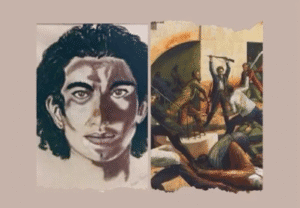
“Assisted by a few others like Charles Nogues, Joachin Philip, Jean Pierre La Valette, Stanislaus Besson, and Jean Fédon (his brother), planning for the rebellion began in March 1793, when Fédon and those he enslaved began converting his Belvidere plantation into a fortified headquarters and planting crops for his army. Throughout the rebellion the rebel army had a system of looting, pillaging, and burning the island’s plantations, while warring with the British. Fédon, after removing the British governor if the island, effectively held control of Grenada for near 16 months. Nonetheless the British Royal Navy maintained a blockade of the island which led Fédon’s army to becoming isolated with lack of reinforcements and military supplies. In June 1796, the British launched another attack on Belvidere and this time overtook Fédon’s forces. While it is unknown what happened to Fédon himself,xii his rebellion stimulated anti-slavery debate in Britain and was used as an example in the abolitionist campaigns that pushed for abolishing the transatlantic slave trade.”xiii
By 1810, there were 30,000 enslaved persons in Grenada, cultivating mainly sugar and cotton across the island.xiv By 1830, when surveys were conducted in preparation for the abolition of enslavement in 1833, there were 23,880 enslaved persons in Grenada distributed across urban enslavement and 604 plantation estates.xv The British governmentxvi, paid the planter class attached to Grenada £615,671.xvii The rest of the compensation package paid to Grenada’s planter class was ‘paid off’ in the profits reaped from the unwaged labour of emancipated populations during the Apprenticeship system from 1834-1838.xviii This compensation package is a fraction of the profits reaped throughout the system of chattel enslavement prior to Emancipation in Grenadaxix, let alone of the colonisation that followed until Grenada’s independence in 1974.
This brief overview of Grenada’s history under chattel enslavement illustrates the complex social relationships under colonisation, the persistent resistance of its indigenous people and later enslaved populations towards living on their own terms. These movements were matched, and to a great extent outpaced by the vicious colonisation of French and British imperial powers. Following independence, attempts were made at repairing Grenada’s inherited injustice, most effectively during the New Jewel Movement’s revolution and transformative system change from 1979-1983. Maurice Bishop’s radical decolonial methods, bettering literacy rates, healthcare access, employment and nutritional self-sufficiency across Grenada, were thwarted by US and British imperialism in 1983.xx The October 1983 US invasion replaced the NJM organisation with a puppet government that would maintain neo-colonial interests in Grenada and in the region.xxi Fighting for reparations in Grenada has a longer history than the movement for reparatory justice today, and the need for repair remains as urgent.