
“Emancipation was a transaction”: Freedom in Writing and Freedom in Practice
August 13th, 2025
By: Nyala Thompson-Grunwald, Researcher, The Repair Campaign
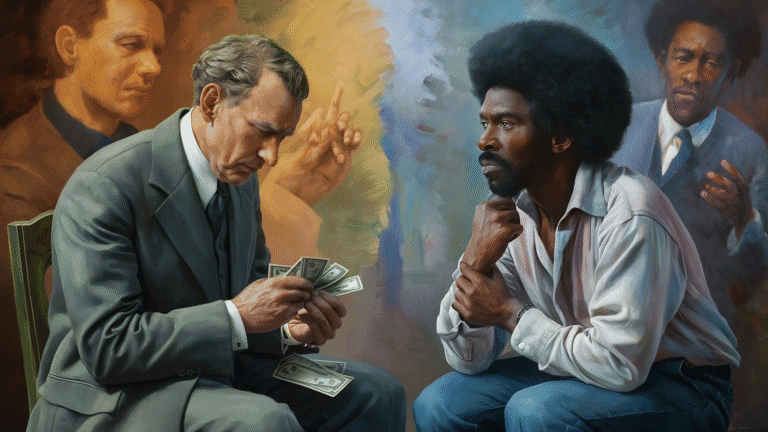
By the late 18th century, the British Empire had actively participated in committing widespread genocide, regional warfare and institutionalising racialised oppression through the system of chattel slavery and the transatlantic slave trade.
Chattel enslavement was abolished several years after the transatlantic trade was abolished by the British in 1807. The abolition of the transatlantic trade does not mean that trafficking captive African populations ended abruptly: to a great extent, the British abolished this within their own empire in the name of economic and trading interestsi. Shipping records demonstrate captives being trafficked across to British Caribbean islands after 1807, after 1834, and in some cases after 1838ii. What did end abruptly was the frequency with which ships crossed the Middle Passage for British Caribbean plantation colonies.
The abolition of chattel enslavement also holds far more than a simple before and after story – before; unfreedom, after; freedomiii. Long-standing grassroots resistance, abolitionist movements on both sides of the Atlantic pushed Emancipation into legal existence. This was not the Emancipation that was fought for or aspired to. This was Emancipation in the name of empire.
How does the story go?
Indigenous, and later enslaved and/or maroon African populations, consistently fought the occupation of those who thought themselves divinely entitled to own lands and bodies in the Caribbean. The fight for freedom, across every island in the Caribbean, British or otherwise, predates 1833. The lead-up to the Abolition Act was marked with the organised, widespread resistance movements of enslaved populations for their unconditional, and self-determined freedomiv.
The Haitian Revolution forced this into reality in 1791, pushing the new French state to abolish enslavement in the first instance in 1794 – this legal process was an example that later inspired Britain5. The realisation of an independent Black Republic in 1804 was a part of a wider global influence on British chattel enslavement: the 1791 Revolution stripped the main economic competition of British plantation colonies, and still struck fear within the enslavers who were already outnumbered and facing constant revolutions in the British Caribbean island coloniesiv.
Such global trends external to Britain, as well as the expanding imperial interests of the British across the world meant several things. One of them was that Britain could no longer rely primarily on sugar7. Nonetheless, Britain was committed to the colonial ideology they – and European colonial powers – created, as the ’civilisational saviours’ of ‘primitive’ environments and ‘subhuman races’.viii
Of course, the above is a complete myth. Colonial fantasies that set the stage for Britain to pull off one of its greatest lies in its vast – truly vast – history of domination: to ‘grant’ the freedom of the enslaved while advancing their property rights and interests even more in the plantation colonies.
Emancipation was a transaction first and foremost, passed between the headquarters of empire and its representatives.ix The ‘An Act for the Abolition of Slavery throughout the British colonies; for promoting the Industry of manumitted Slaves; and for compensating the Persons hitherto entitled to the services of said Slaves’ declared the nominal freedom and change of status of enslaved populations to emancipated populations.x Freedom itself, in who got to own land, who got to decide whose wages, who could worship such faith or who could express such creativity and create such community, who decided how to build up island-wide income and ways to feed and provide for everyone…all these questions did not even begin to be realised until after 1838xi. And once they were addressed, it was by those who owned/had owned enslaved persons and yet still, consistently fought for by those whose freedom, by their say, was restricted and denied.
How was Emancipation passed into law?
In 1833 when the British government passed the Abolition Act, this legalised the initial manumission of enslaved persons to apprenticed labourers in its plantation colonies in the Caribbean and Cape from 1834.xii This Act would not be accepted by members of British Parliament (MPs) without ‘reparations’ – compensation paid to those of their members and class which lost so-called property – human and non-human.xiii
Records indicate that several MPs were themselves owners of plantation estates or of enslaved persons – 1 in 10 enslavers (as in, those whose name was on a legal document indicating property) were absentee owners.xiv Those who voted on whether to abolish chattel enslavement and how were themselves those who did not want to abolish enslavement without being able to continue profiting from the region.xv Correspondence between MPs indicates that their primary concern in the passing of the Abolition, was whether their interests would be served, and how best to manage the Caribbean colonies as the ‘negroes’ were incapable of civilization or industry of their own agency [this is a paraphrased quote]. xvi
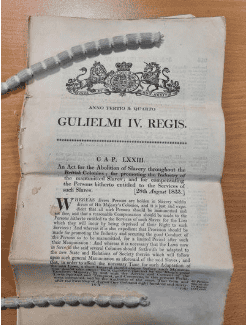
Over half of the Act was dedicated to organising how this compensation would be valued and assessed.xvii A committee specific to the distribution of compensation was established and sent to each of the Caribbean, Cape Colony and Mauritius plantation colonies, valuing how much land, how many enslaved persons each enslaver could ‘claim’ as ‘property loss or damage’. xviii
For instance,
- Colonies were classed according to old and new plantation colonies, depending on the time that they were colonised by the British, when plantation estates were carved into the land, when captive African persons were trafficked to the islands…Barbados, St Kitts, Jamaica were classed as old plantation colonies, very little fought over or relinquished by British occupation.xix On the other hand, Tobago, St Lucia, Trinidad…were classed as new colonies, as Tobago changed hands approximately 32 timesxx, and St Luciaxxi about 13.xxii Trinidad was colonised by the British from the late 18th century.xxiii This meant that the value attributed to new plantation colonies could be higher than the value attributed to old plantation colonies – these lands had been deeply violated until they could yield little fertile ecosystems.xxiv
- There were different ways of ‘owning’ enslaved property under chattel enslavement, ‘owning’ land, ‘owning’ bodies…Depending on what ‘type’ of property was owned, there was a different value.xxv The rates placed on human life and environments were placed on lives that, at the time in which enslavers’ claims for compensation were being recorded, was a fraction of the lives trafficked to, tortured, murdered, assaulted in the Caribbean during chattel enslavement.
- British plantation colonies in the Caribbean were entirely carved up into plantation estates, with the aim to always extract more, exploit more.xxvi It is dangerous to reduce the data from the compensation that had to go hand in hand with the Abolition of chattel enslavement to mere numbers. Emancipation was a transaction in colonial law, as a colonial documentxxvii, but the memory of the land, of our peoples with regards to the values put on this estate and on that next one, testifies to the real legacies of the memory of Emancipation in the Caribbean.
What does Emancipation have to do with reparations?
The cost of compensation to all enslavers in the Caribbean, Cape Colony and Mauritius plantation colonies was near £50 million – at a simple consumer price index (CPI) valuation, this translates to £5,176,253,664.03 today.xxviii
i Scanlan 2020, Slave Empire: How Slavery Built Modern Britain, Little Brown Book Group
ii Eltis D & Richardson D eds (2008), Extending the Frontiers: Essays on the New Transatlantic Slave Trade Database, Yale University Press
iii Manjapra K (2022), ’Chapter 3. British Antislavery and the Emancipation of Property’, Black Ghost of Empire: The Long Death of Slavery and The Failure of Emancipation, Penguin Books, pp.69-95
iv See previous reference
v See previous reference
vi See previous reference
vii Williams E (2021), Capitalism and Slavery, 3rd edition (1st publication 1944) University of North Carolina Press,
viii Rodney W (2019), The Groundings with My Brothers, Verso Books
ix Manjapra, Black Ghost of Empire
x See previous reference, ‘An Act for the Abolition of Slavery throughout the British colonies; for promoting the Industry of manumitted Slaves; and for compensating the Persons hitherto entitled to the services of said Slaves’, PC 1/4444 held at the National Archives UK, Kew, accessed by NTG the 26/03/25
xi Beckford G (1983), Persistent Poverty: Underdevelopment in Plantation Economies of the Third World, 2nd edition Maroon Publishing House and Zed Books,
xii ‘An Act for the Abolition of Slavery throughout the British colonies; for promoting the Industry of manumitted Slaves; and for compensating the Persons hitherto entitled to the services of said Slaves’, PC 1/4444 held at the National Archives UK, Kew, accessed by NTG the 26/03/25, Manjapra, Black Ghost of Empire
xiii ’Accounts of Slave Compensation Claims; for the colonies of Jamaica, Antigua, Honduras, St. Christopher’s, Grenada, Dominica, Nevis, Virgin Islands, St.Lucia, British Guiana, Montserrat, Bermuda, Bahamas, Tobago, St.Vincent’s, Trinidad, Barbadoes, Mauritius, Cape of Good Hope, ordered by the House of Commons, to be printed, 16 March 1838’, accessed through The Internet Archive 02/25 by NTG
xiv Conversations with Prof. Padraic Scanlan and The Repair Campaign, 02/25, ‘The Unique Brutality of Chattel Slavery’
xv See previous reference
xvi Correspondence with ‘An Act for the Abolition of Slavery throughout the British colonies; for promoting the Industry of manumitted Slaves; and for compensating the Persons hitherto entitled to the services of said Slaves’, PC 1/4444 held at the National Archives UK, Kew, accessed by NTG the 26/03/25
xvii See previous reference, Manjapra, Black Ghost of Empire
xviii See previous reference
xix Higman B.W (1984), Slave Populations of the British Caribbean 1807-1834, John Hopkins University Press, Conversations with Prof. Matthew Smith (University College London) and The Repair Campaign in July 2025
xx Oral History received by NTG
xxi Oral History received by NTG
xxii See previous reference
xxiii Brereton B (1981), A History of Modern Trinidad 1783-1962, Heinemann Educational Books
xxiv Ferdinand M (2019), Une écologie décoloniale: Penser l’écologie depuis le monde caribéen, Editions du Seuil
xxv Conversations with Prof. Nicholas Draper (Centre for the Study of the Legacies of British Slavery) and The Repair Campaign in May 2025
xxvi Ferdinand, Une écologie décoloniale
xxvii Conversations with Prof. Matthew Smith (University College London) and The Repair Campaign in July 2025
xxviii Re calculating the worth of near £50mil to latest available information, which is 07/25, there are several ways to make this calculation. One way is to calculate by inflation, eg what did a loaf of bread cost in 1833, and what does it cost now? There is also by economic worth, which calculates according to the GDP worth of a country’s economy in 1833 until now, and takes into account the changes a country’s economy undergoes. These are only 2 ways out of several to make this calculation. For the purposes of accessibility and ease of understanding this information, we’ve chosen to translate this information according to Consumer Price Index(CPI) , which is according to inflation. For more information on the different prices specific to Abolition alone, please see Manjapra, Black Ghost of Empire, Draper N (2013), The Price of Emancipation: Slave-Ownership, Compensation and British Society at the End of Slavery, Cambridge University Press, Beckles H (2021), How Britain Underdeveloped the Caribbean: A Reparations Response to Europe’s Legacy of Plunder and Poverty, UWI Press. The first resource is extremely accessible and comprehensive to all, the second source is very specifically from the expertise and field of economic history, and the last resource is also specifically from the field of history. Together – among other sources of course – these works put together an economic story of the cost of Abolition, and why this cost was a fraction of the profits reaped from chattel enslavement.
xxix Manjapra, Black Ghost of Empire,
xxx Conversations with Prof. Nicholas Draper (Centre for the Study of the Legacies of British Slavery) and The Repair Campaign in May 2025
xxxi See previous reference
xxxii Manjapra, Black Ghost of Empire