
Hewanorra – as named by the Kalinago – now called St Lucia, is an island that demonstrates the consistent fight waged against the European occupying presence from the first point of invasion. The entire Caribbean archipelago tells stories, in their peoples and lands, of making resistance to European invasion as natural and necessary as breathing, and this no matter whether the resisting population is First People indigenous or made-indigenous.i French and British colonisation implemented violent harms into the human and natural ecosystems of the island, the festering traces of which are still evident today.ii The roots of colonialism were never uprooted when colonial power was removed through the 1960s-70s statehood and independence processes.iii Nonetheless, St Lucia demonstrates that fighting for better is an enduring and necessary struggle.
From Hewanorra to St Lucia, island to plantation colony
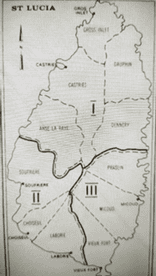
There are several petroglyphs inscribed into the features of Hewanorra, testifying to a deep history of its First People indigenous civilisation. The beginning of Europe and the West in the Caribbean – which has yet to fully have its ending by any means – is brutally transformative to our region, but needs to be understood as having a beginning within the overall history of the Caribbean itself: our history does not start with Columbus in 1492 getting lost in the world trying to find a new route from the ‘East’ to continue Christian Empires’ barbaric crusade against Arabic Empires and Islamic populations in the now-so-called ‘Middle East’. Please note that this last sentence is in reference to 1492, not its very real spectre in 2026. Hewanorra’s history, likewise, does not start with French colonisers bullying their way through Kalinago populations into an apparent treaty in 1650 and widely forcing their occupation from the first boats trafficking African captives in 1724 and the partition of the island into quarters from 1744. On a map of Hewanorra, it can be noted that, at least in parish names, the French linguistic colonisation of Hewanorra was complete.iv To this day, Lucian kweyol – a creolised language with French, English, West African elements specific to St Lucia – is more colloquially spoken than the states official language, English.
Between 1724 and 1808, 9,738 African captives were embarked in the western ports of the African continent and trafficked across the Middle Passage where 8,835 enslaved bodies marked as ‘chattel’ disembarked. The Slave Voyages Database also records 31 voyages trafficking enslaved persons within the American continent from 1729 to 1808. This corresponds with the note that the first waves of French planters in St Lucia were from other islands at the time occupied by the French, such as Martinique for instance.v Across these 31 voyages, 1,296 enslaved persons were embarked and 1,247 disembarked. For both routes of trafficking, the records indicate an estimated mortality rate of 8.6% alltogether; captives whose graves are swept away by the waters of the Middle Passage or the Caribbean Sea. The cultivation of the plantation economy prized crops in the Caribbean, notably sugar and coffee, rendered St Lucia land commodified and regularly fought over between the British and the French for monopoly of wealth extraction for most of the 18th century. These colonial aspirations were executed through the ruthless conditions of enslaved populations on the plantations, and yet matched by the resistance of populations made indigenous to St Lucia and with something as urgent and yet more significant than breath to fight for: freedom.
Twice Emancipated: The Brigands’ Reclamation of Freedom
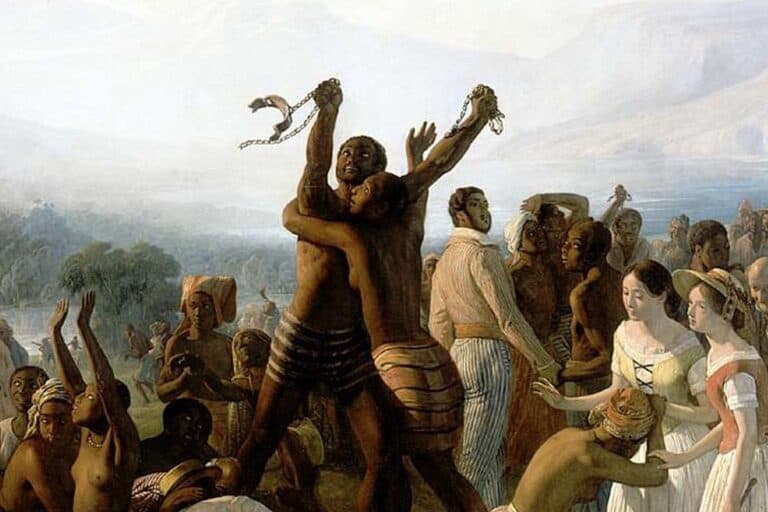
The French Revolution of the late 18th century affected every part of the developing global transatlantic economy defined and sustained by genocide and the trade of human bodies. Notably, the Haitian Revolution in 1791 fully emancipated its fighters and enslaved population, forcing French revolutionary governments to fall in line and abolish enslavement for the first time in the French Empire in February of 1794. St Lucia was therefore emancipated, until – still being bounced back and forth between the French and British invading and occupying forces – April 1794, where the British invaded and captured the island.vi Armies of emancipated populations formed, some led by Flore Bois Gaillard, a previously enslaved woman who took up arms to never be entrapped in a wholly physically, psychically, sexually abusive and dehumanising system as enslavement again. The Brigands, or ‘armée révolutionnaire française des bois’ as the army is sometimes recorded [revolutionary French army in the bush], in a year and 3 months pushed back the British until the defeat of its occupying forces on June 19th 1795. Lucian revolutionaries emancipated themselves from the British and began exploring and implementing their freedoms for a year, until the British occupation in 1796 which triggered the next stage of what is now recorded as the Brigands War, lasting until 1797.vii The brigands’ struggle for Emancipation from the British was obtained years before St Lucia was emancipated for a second time in 1834.
The Brigands War is recorded to have “scorched the surface of the island, depleting its population and vandalising its landscape”, testifying to the voices of those who record our histories. The primary source records that have lasted from this period are primarily French and British colonial sources, whereby complete degradation and ruin of land and people will have been measured in terms of commodity and colonial property and value – human and otherwise. The ‘vandalising’ of plantation estates must have been devastating indeed – and apparently required massive rebuilding efforts at the cost of newly re-enslaved populations blood and lives – but had Lucia’s ‘année de liberte’ [year of freedom] lasted beyond a year, beyond the presence of French governance similar to Toussaint position immediately post-emancipation in Haiti (still St Domingue at that time), what exactly had been scorched that could not have been rebuilt differently, created from the psyche of a people that had freed themselves?
According to Higman’s data covering the entire British Caribbean from 1807-1834, by 1810 55% of the St Lucia’s enslaved population were allocated to sugar plantation estates, 22% to coffee plantation estates, the two primary crops cultivated on a largely monocultural basis on the island.viii In 1815 this had risen to 59.5%, or 9,713 enslaved persons.ix This population produced 0,20 tons of sugar per enslaved person a year between 1815-1819.x That’s an estimated 1,942.6 tons of sugar a year for that time period alone. Bearing in mind once again, that sugar plantations often corresponded to higher mortality rates related not only to the overarching genocidal system of chattel enslavement, but also to the higher need for equipment and technology a coerced and deemed-disposable workforce was not protected from, matched with a far higher demand for the end product of sugar. Sugar plantation estates required large spaces, large numbers of enslaved populations, excruciating physically intensive labour, and far more technical manufacturing processes than other crops such as coffee or cocoa demanded.xi The configuration of space (or lack thereof) and labour that this meant for enslaved populations – deliberately malnourished, under-treated medically, tortured, abused – alongside a crop harvested in blood is telling in available data. Were mortality rates available for respective specific plantations in for instance, St Lucia, it would be another piece of data that could identify the crop cultivated on the given plot of land, the survival conditions of enslaved populations there as well as the archive lingering in land memory. By 1830 68.5% of Lucia’s enslaved population were allocated to sugar plantation estates.xii
Higman notes that by 1831 the sugar plantation estates covered 4,049 acres of the island from leeward to windward, with the provision allotments also covering 4,049 acres.xiii Higman notes that from the primary source data available, it is uncertain whether the number of acres of provision grounds included grounds cultivated by enslaved populations living on sugar plantation estates. With this uncertainty in mind, some awareness of the spatialisation of these acres is important, as while plantation estates covered large stretches of land at a time – particularly sugar estates, which required plenty of land – provision ground allotments were far smaller and attributed to a few households at a time to accumulate nutrition where possible on the margins of estates. Enslaved populations across the Caribbean transformed these meagre distributions into its own internal economy subaltern to the overwhelming and lasting function of the plantation economy.xiv In several so-called ‘small islands’ in the Caribbean, the fundamentals of a provision ground economy is still visible in local trading and nutrition systems.
The fact that St Lucia had a thriving provision ground economy, following Higman’s data, testifies to this local economy as its own movement of resistance to an extractive agricultural and economic system that would pervade every part of colonial infrastructure past independence. The access to these lands was reorganised by the British under Emancipation and Apprenticeship 1834-38, nonetheless the strategy remained, as a crucial part of restorative justice linking human and natural ecosystems. In fact this internal economy partly contributed to the frequency of manumission rates in 1834 in St Lucia.xv
- The manumission system in British Caribbean colonies is far more complex than time frame allows in this post, nonetheless what it (briefly) means is a system where freedom could be purchased through a sum of money fixed by colonial judiciary processes, or enslavers or….paid off just so or in a fixed quantity of labour.xvi The 1834 Emancipation legislated by the British Empire for instance, was a transaction based on manumission processes, imitated from Northern American pre-existing legislation. Manumission says that an enslaved person now has an expiry date to their enslavement, either bought off in years of labour or in money. The variables as to how this manumission could and was obtained include whether these were rural or urban enslaved persons, African-born or Creole (in the case of colonial records and associated historiography, this simply means enslaved persons born in the Caribbean for instance), the gender and age of the enslaved personxvii….
In the instance of St Lucia, there could be a connection drawn between the fact that in 1834 alone, its rate of immediate manumission (so, in money payment) was, in the entire Caribbean, second alone to the Bahamas islands.xviii St Lucia’s rate of manumission between 1820 and 1834 jumped by 82.2%, largely due to shifting regulations around how manumission could be obtained at the time of British Emancipation.xix Enslaved persons did not suddenly enter some form of massive cash flow, nonetheless the provision economy held the potential for “superior opportunities for the accumulation of cash”. Here for instance, St Lucia still had all those acres of provision grounds which yielded crops that were sold and exchanged in an apparently relatively thriving internal economy. There is a connection that could be made – requiring further in depth research – between that massive jump in manumission obtained per 1000 slaves between 1820 and 1834, and the differences in provision ground economies between St Lucia and other islands with fewer rates of manumission. As mentioned above, this is certainly not the only factor linking this, or the only factor contributing to manumission rates in the British Caribbean.xx It is a connection that further highlights the consistent struggle for ‘Emancipation from below’ against the policies implemented by colonial interest in the name of colonial interest.xxi
Reparatory Futures
Through this brief engaging with Hewanorra, St. Lucia’s histories of resistance and chattel enslavement , it is clear that fighting for what reparatory justice means is in no way a new struggle in St Lucia. The island’s history testifies to the lingering traumas of colonisation even with consistent relentless and adaptive resistance in practice. Lucian freedom fighters manœuvred obtaining their freedoms in as many ways possible, carving out spaces within an existence defined by margins. These movements underscore a powerful regional narrative of resistance that must persist today, be this against the reproduction of internalised colonial trauma at home and abroad, against external imperial forces, and/or together with regional movements for reparatory justice.