
Chains of the Past: The Lingering Rot of Colonisation in our Psyche
29th January 2026
By: Nyala Thompson Grunwald, Content Researcher for The Repair Campaign
The Prime Minister of St Kitts and Nevis is, since January 2026, the chair of CARICOM for this current six-month rotation. This period under Prime Minister Drew’s leadership holds great potential for the betterment of reparatory justice movements in the Caribbean.
Recent statements and agreements from members of regional leadership also indicate how starving we, as Caribbean populations and communities, are for the heavy work of self-repair as a part of reparatory justice. The histories of colonisation are so deeply inscribed into our psyche for us self to often reproduce its harms. As made evident by the actions of some of our own regional leadership, this internalised violence is symptomatic of all Caribbean populations regardless of colour creed and/or class
This article aims to untangle some of St Kitts and Nevis’ histories under the genocidal violence of chattel enslavement, to further understand that the harms of colonisation went farther than human body and natural ecosystems, these are transgenerational harms that fester today in the way we think, speak, move.
The moment of Emancipation in the Caribbean is considered as pivotal in the progression of freedoms for enslaved populations in the Caribbean, as it was. This moment was also pivotal in the progression of repression, of colonisation of body and mind for then emancipated populations in the Caribbean.i The following quote, “there was a generally accepted belief that a period of transition to full freedom was necessary, a familiar sentiment in modern white-supremacist regimes” further exposes the ways that Emancipation was designed to transfer a colonised psyche from emancipated to descendent.ii Much as, under the system of chattel enslavement itself, enslavement was transferred from mother to child, under the system of Emancipation in the Caribbean it appears that the supposed ‘gift’ of freedom was to be transferred from emancipated populations to their descendents. As, legally, it could be argued that this ‘period of transition to full freedom’iii was not achieved – in this case, in the British Caribbean – at the end of Apprenticeship in 1838, but in independence in the 1960s. And there are several existing debates arguing whether full freedom was ever truly achieved with the hands of power shifting from colonial to local elites, preserving the very same administrative systems that were designed for the purpose of human ownership.iv
vSt Kitts and Nevis, at the time of Emancipation, was the British Empire’s oldest plantation colony in the Caribbean. Occupied by European invaders from 1625, the islands of Liamuiga and Oualie were split under French and British occupation between 1627 and 1713. The treaties cementing this colonial cohabitation were modified five times between 1627 and 1662, with uninterrupted British occupation overtaking both island from the mid 18th century. There are a few key pieces of information to present a brief overview of St Kitts and Nevis’ histories under chattel enslavement:
- From 1644 to 1803, according to latest information, a total of 175,523 captives were trafficked across the Middle Passage to St Kitts and Nevis (SKN).
- The highest point of this transatlantic slave trade were from 1733-1779, where 62.2% of the total trafficking records to SKN took place, with a latest available total of 109,241 captives over 43 voyages.
- These numbers correspond to Hubbard’s analysis from primary sources that, “in the eighteenth century, it was noted that nearly two-fifth of newly imported slaves died within a year of arrival, and that on plantations where the annual sugar production averaged one hogs head per slave, slaves died faster than the natural increase of population. On plantations where the average was two slaves per hogshead of sugar produced, the slave population increased faster than it died”.vi As well, these numbers correspond to Higgins’ analysis that, “Between 1760 and 1810 St Kitts had consistently produced more sugar than Barbados…the ratio of sugar to slaves remained higher than in Barbados until 1834”.vii Let’s break this down.viii
- For this information, I chose two time periods, one the year 1749, which according to the Slave Voyages Database is the highest point of captives trafficked across the Middle Passage to SKN, and one the five-year range from 1760-65, to fit with Higgins’ timeline indicated above. Both time periods are within Hubbard’six analysis, as well as within the range of years that trafficking across the Middle Passage to SKN was most significant.
- In 1749, 5,902 captives were embarked and 4,866 captives disembarked, with a recorded total of 1,036 captives killed in crossing, a 17.5% mortality rate for that year alone. Within a year of that, according to Hubbardx, 2/5ths of newly arrived captives were killed, 40% of disembarked survivors, about 1947 persons killed within a year.
- Between 1760 and 1765, a total of 20,327 captives were embarked and 16,684 survivors disembarked (an 18% mortality rate across that range) with, across that range, 3,643 captives killed in crossing, and, of the surviving disembarked, an average of 6,674 killed within a year.
- From the first part of this information, there is a mortality rate combined between the mortality rate across the Middle Passage, and the mortality rate of disembarked survivors within a year. Put together, for the year 1749 is a mortality rate of 49,5% and for the period of 1760-65, a mortality rate of about 33%. The first year of chattel enslavement following captives’ disembarkation was widely called ‘seasoning’ in the Caribbean, a period in which human chattel was brutally ‘broken into’ its role as disposable labour force and inhuman, unfree commodity. Survivors were confronted with the brutality of chattel enslavement on the bones of those that did not survive this period of ‘seasoning’.
- For the second part of this information, while Hubbard’s information is dated to the 18th century, Higgins’ data carries this estimation into the 19th century.xi While the plantations on which there is an average of one hogshead of sugar produced per one enslaved person is unspecified, we can interpret from the available information we have about the production of sugar per enslaved person in the 19th century to understand a little more about the genocidal conditions of chattel enslavement, here specific to SKN.
- Hubbard indicates that if there was an average of one hogshead per one enslaved person produced, the mortality rate on plantations was higher than the birth rate.xii If there was an average of one hogshead per two enslaved persons produced, the mortality rate was lower than the birth rate. Higgins provides the primary source records for the numbers corresponding to that information, in the 19th century.xiii
- A hogshead of sugar is 0.203213 tonnes, 2 hogsheads are 0.406426 tonnes. According to Hubbard, in the 18th century this would average at one enslaved person producing that on average a year. Higgins indicates that from 1815-19, an average of 0.34 tonnes of sugar were produced per one enslaved person.xiv That’s an average of 1.6 hogsheads of sugar per enslaved person, which would push Hubbard’s analysis in the 19th century to an overall mortality rate that is higher than the rate of reproduction of the enslaved population. This corresponds with the information Higgins holdsxv of the natural increase of the enslaved population from 1817-22 versus the number of deaths in the same period, with an estimated 40 to 50% difference between the natural increase (the lower number) and the mortality rate (the higher number).
- The above data puts together information available for St Kitts and Nevis. Specifically for Nevis, an 1828 map of SKN (see below) shows that there was 40% of caneland in Nevis – with “almost no break in the succession of wedge-shaped estates”.xvi Nevis was the first island under British colonisation to shift entirely to the monocultural production of sugar which as early as 1652 was noted “as being the richest British possession in the western hemisphere…it [Nevis] produced more than double the amount of sugar grown by all the other English Leewards combined…Nevis still out produced Jamaica in 1700”.xvii

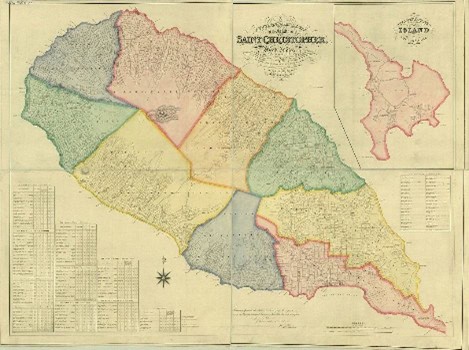
- The carving up of land for the exclusive cultivation of sugar – if 40% of Nevis land was cane land the other 60% were residential areas, allotments or mountainous areasxviii – also predetermined the brutality of enslavement for those considered chattel.

i Conversations with Professor Matthew Smith, Director of the Centre for the Study of the Legacies of British Slavery at University College London, August 2025
ii Frucht (1975), ‘Emancipation and Revolt in the West Indies: St Kitts, 1834’, ‘Science and Society’ Sage Publications Ltd, p.383
iii See previous reference
iv See for instance the ‘New World Group’ journals, widely digitally accessible. See also the Lloyd Best Institute for instance.
v The Repair Campaign research
vi Hubbard (2002), A History of St Kitts: The Sweet Trade, Macmillan Books
vii Higgins (1985),Slave Populations in the British Caribbean 1807-834, Hopkins Press
viii For the following section primary source information cited as below interpretation and analysis by NTG
ix Hubbard (2002), A History of St Kitts: The Sweet Trade, Macmillan Books
x See previous reference
xi Hubbards, A History of St Kitts, Higgins, Slave Populations
xii See previous reference
xiii See previous reference
xiv See previous reference
xv See previous reference, p.308
xvi William MacMahon, See previous reference
xvii See previous reference
xviii See previous reference
xix The Repair Campaign research