
Beyond Emancipation: Negotiating Freedom in Antigua & Barbuda
21st September 2026
By The Repair Campaign
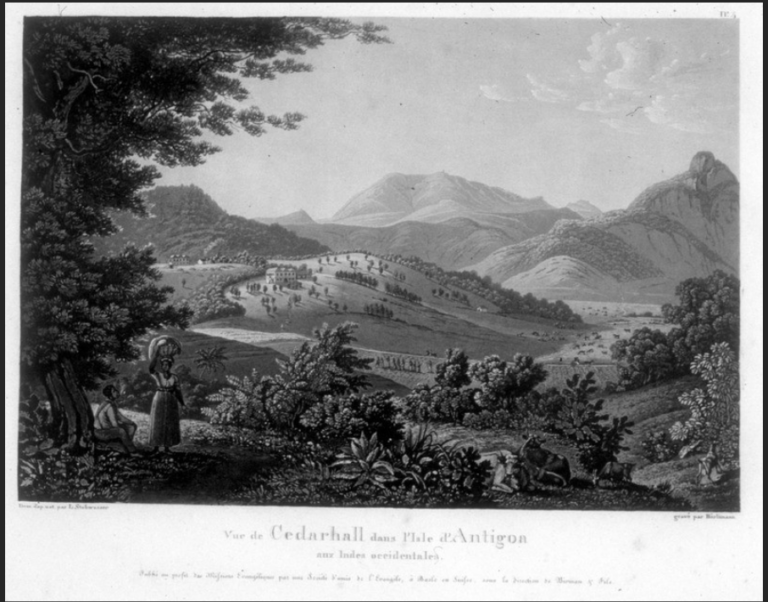
This image illustrates a view from settlements set up in Antigua by Moravian missionary occupation in the early 19th century. Here, this Moravian settlement with a view on Cedarhall set up a church in 1822 providing mandatory beginning education for enslaved persons. Missionary education in the lead-up to the abolition of chattel enslavement instructed the gift of freedom and civilisation to African populations as gifts from the British Empire.i Part of a wider colonial narrative around Emancipation, freedom for Black persons was considered impossible without some form of colonial education, some form of coerced labour…ii In this narrative, Black freedom had to be supervised, controlled, regulated. Christian missions in the British Caribbean were a key part in imparting into the psyche of enslaved persons the racial ideology of white supremacy and Black subhumanity. This view from Cedarhall is spread between at least 2 estates, for instance the Golden Grove and Jolly Hill estates, respectively in St John’s and St Mary’s parishes. In 1821 the number of enslaved persons between these two estates were combined in the Antiguan Slave Registers with Barnacle Point estate in St George’s, likely as they were all owned by British planter Bertie Entwisle. In 1835, his nephew Ralph Peters, trustee of his will, was granted the claims for Entwisle’s estates in Antigua and St Vincent under the1834 Abolition Act. Jolly Hill and Golden Grove estates, where respectively 240 and 165 enslaved persons laboured, granted Ralph Peters the sum of £3,804 14S 2D and £2363 5s 9d on those claims alone. The cost of freedom defined the application of Emancipation in the British Caribbean from 1834. In Antigua, the tensions around who determines freedom, what values are placed on legal freedom, how it is thought of and lived by freed Black populations takes a different shape as the rest of the British Caribbean, as neither Antigua nor Barbuda colonial authorities implemented the Apprenticeship system. This piece briefly considers this differential model of Emancipation.
Waladli/Oüaladli, W'amoni/Oüahómoni
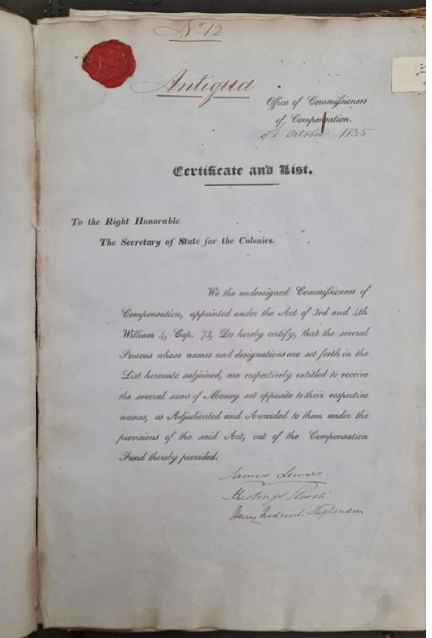
Across plantation colonies, emancipations ‘granted’ the legal status of freedom, while preserving the logistics of land dispossession and disenfranchisement to sustain a race and class of disposable and ‘subhuman’ labour
Leading up to eventual abolition of chattel enslavement, the Antiguan planter class was determined not to enter the announced apprenticeship process. Ideologically the Antiguan planter class fully aligned with the outlook of Apprenticeship – the necessity for Black freedom to be gradual, supervised.ix Economically a different model of Emancipation was preferred, with the aim of guaranteeing a more profitable transition outside of chattel enslavement, The Contract Act was passed in Antigua in December 1834, defining another strategy for Emancipation to establish “black working people enduring a freedom that functioned too much like slavery”.x
A core part of this Act is that, if freed populations were to live on an estate then they had to enter a contract to work on that estate for at least a year. While the Act was written in such a way to standardise conditions of employment for Antiguan freed populations, inconsistencies within hiring practices and wages made cracks through which Antiguan emancipated populations could negotiate how they lived their freedoms.xi The Contract Act highlights a key fear and reaction of the British planter class and colonial authorities from Emancipation: mobility. Literally landlocking employment and housing gave the planter class greater control on the movement of freed populations. Crucial to setting up Caribbean society, economy and industry from Emancipation was the ideology and practice of valuing freedoms. Where and how freed populations lived, grew food, sourced some form of income, took care of themselves and families…these realities were essential to be controlled to satisfy the economic and industrial interests monitored by British imperial wealth and profit, as well as to satisfy the systems of dehumanising domination measured by the prescribed ‘subhumanity’ of African and African-descendent populations.xii Supervising and policing the movements of freed populations was therefore essential to maintaining a social order built on theft. How Antiguan freed populations figured out strategies to move from one estate to another under the limitations of the Contract Act, created new sources of income, strengthened inter-island networks simply by moving around between communities…these are strategies that reclaimed ownership of freedom on the terms and conditions of colonial bureaucracy.xiii
Freedom was a valued and valuable variable in emancipation processes in the Caribbean. How emancipated populations determined freedom within the limitations imposed by Emancipation in the British Caribbean shaped the development of modern societies in our archipelago.
What Antigua and Barbuda’s histories highlight are the realities of negotiating freedom within the constraints of colonial policy. Chattel enslavement forced survival, resistance, existence within the repressive margins of colonial brutality and violences. Freedom, despite promising liberation from these traumas, simply translated those margins. Where enslaved populations were forced to negotiate a set of dehumanising parameters, freed populations were forced to negotiate freedom within another set of dehumanising parameters that were overlaid with the first set. In Antigua and Barbuda, the Contract Act lasted until well into the 1930s-40s. It consistently bears repeating; how Emancipation was applied in the Caribbean archipelago did not close a lid over chattel enslavement, it established a portal through which the foundations of that genocidal system could be reproduced and shape-shift through generations of Caribbean development and society. The very act of creating new jobs, new sources of income within the cracks of what Emancipation stipulated in Antigua and Barbuda speaks to what we live today as a hustle economy, finding and often creating different sources of income to survive and to provide. These are acts that reclaim economic self-determination, but crucially they are acts driven by engineered system underdevelopment that demands correction through reparatory work.
i Conversations with Professor Matthew Smith, interview related in ‘Remembering Emancipation on both sides of the Atlantic’, The Repair Campaign 13/08/2025
ii Lightfoot, N. (2020) Troubling freedom: Antigua and the aftermath of British emancipation Natasha Lightfoot. Durham: Duke University Press.
iii Lightfoot, N. (2020) Troubling freedom: Antigua and the aftermath of British emancipation Natasha Lightfoot. Durham: Duke University Press.
iv Higman B.W (1986), Slave Populations in the British Caribbean, 1807-1834, Anthony Hopkins Press
v Lightfoot, N. (2020) Troubling freedom: Antigua and the aftermath of British emancipation Natasha Lightfoot. Durham: Duke University Press.
vi See previous reference
vii See previous reference
viii Lightfoot, N. (2020) Troubling freedom: Antigua and the aftermath of British emancipation Natasha Lightfoot. Durham: Duke University Press.
ix See previous reference
x See previous reference
xi Lightfoot, N. (2020) Troubling freedom: Antigua and the aftermath of British emancipation Natasha Lightfoot. Durham: Duke University Press.
xii See previous reference
xiii See previous reference