

Bound by Empire, ‘Three Halves’, Two Islands, One Republic: A Story of Trinidad and Tobago

22nd April 2026

Nyala Thompson Grunwald

Respectively known as Kairi – land of the hummingbird – Aloubaera, now Trinidad, Tobago; both islands were first confronted with Europeans’ genocidal project in the ‘New World’ from 1498-1502. Both islands trace an entirely distinct history from then until Tobago is annexed to Trinidad in 1888-98. This brief – extremely brief, please see hyperlinks and references for far more information – focus on both islands’ histories will consider both islands separately until the point of annexation in the late 19th century. Through this focus, this piece intends to further open up existing conversation and consciousness about the significance of Trinbagonian histories and communities in the ongoing movement for repair. Crucially, it is only a little over a century that Tobago was annexed to Trinidad: although united under one nation and banner now, these are two different islands, cultures, histories, forms of Creole, communities, economies…two entirely distinct ways of relating to each other and to land. The title of this piece calls upon Trinbagonian historian Lloyd Best’s observation of the enduring cohabitation specific to Trinbago – Tobagonians, Afro-Trinidadians, Indo-Trinidadians….all moving as three halves in one whole.i

“Colonisation therefore brought skewed land use and settlement patterns” – Susan Craig-James

Archibald and Woodcock’s texts are useful to understand a timeline of Tobago’s changing of colonial hands – 32 times, 23 of these all before 1763 – between the Courlanders, the Dutch, the French, the English, even the Swedish and Spanish.ii These constant changes are recorded in Tobago’s placenames; such as Auchenskeoch, Bagatelle, Courland, Charlotteville…among others. Aloubaera was recorded as the ‘furthest outpost of the remaining Kalinago civilisation’iii after European invasion devoured the Caribbean archipelago and its First Peoples indigenous populations. The island was also recorded as where First People indigenous populations fleeing European persecution in other islands such as Camerhogne, Yarumein…could get to.iv Kalinago communities scattered across Tobago entered into communication with European invaders similar to communities in Wai’tukubuli, through warfare and commerce – although the natural fortifications Aloubaera had in its environment were not as strong as those in Wai’tukubuli.v Nonetheless, Tobago was signed as a neutral island – so, the same title as Dominica until into the 18th century – in 1684vi The interests driving European invading efforts in Aloubaera were matched by strong resistance even before the first boats trafficking captive Africans reached its shores in 1656 (under the Dutch flag), by the resident First  People indigenous communities.vii The centuries from Columbus’ sighting of Aloubaera between 1498-1502 through the warfare European invaders inflicted across the entire island gradually near-wiped out the resident Kalinago population from their homes: by 1814, only 1 family of 20 was left in Tobago.viii

The 1684 treaty declaring Tobago a neutral island was broken several times by European invaders until the first attempts at British colonisation in Tobago in 1763.ix Tobago was fought over, seized and captured by European invaders after 1763 (for instance the French occupation 1781-93) even with Britain’s more engrained presence.x Uninterrupted British colonisation was established from the early 19th century, where Tobago remains governed with the rest of the Windward islands, until after the collapse of its sugar economy in the 1850s and subsequent redistribution as Crown colony with Trinidad from 1888-98.xi Significantly in the case of Tobago’s histories, while the presence of First People indigenous communities was subject to more geopolitical contention in how European invading forces interacted with Aloubaera, the actual connection between Kalinago civilisation before British uninterrupted colonisation and Kalinago survival after now appears severed.xii There are still today significant voices from what remains of First People indigenous communities in Tobago, as well as incredibly vast trace histories uncovered in the 20th century and presented in Scarborough Fort George Museum. Nonetheless, the connection is largely muted today, which to a great extent can be understood by Britain’s erasing of any ecosystem in the name of sugar.

The entirety of Tobago was cut up into plantation estates but for the rainforest
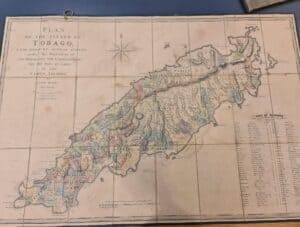
reserve, deemed protected since the 18th century. With the environments in Tobago – flat and hilly for the most part – most of the west part of the island was used for the extensive cultivation of sugar, while the eastern part of the island varied between sugar, cocoa, indigo in the north/east. There were about 23 fortifications along Tobago’s coastline, matching the initial structure of plantation estates as entirely self-contained units with respective access to a port. These fortifications could defend Tobago from whichever European invaders were vying for its occupation. The separation of Tobago’s north/east – or, windward – plantations as described above became more glaring by the early 19th century. At that point British imperial interests were almost entirely focused on sugar,  therefore the concentration of production in the south/west – or, lowland – was accelerated as these were the flatter parts of the island and therefore where sugarcane could grow.xiv As production was more concentrated in the western half of the island , the political and administrative construction of Tobago as a plantation colony under the British Empire was also gradually focused in the western half of the island – a developmental distinction which remains today between top side and low side Tobago.xv I note ‘gradually’, as Tobago had several capitals: first Georgetown near Barbados Bay (on the windward side, southern coastline) then Scarborough in the western half of the island.xv Plymouth remained the second main town in Tobago regardless of capital. In local knowledge, you would have to know Georgetown was the first capital to locate it (colloquially the first capital is sometimes thought that Roxborough, further up windward side and now the 3rd main town in Tobago, was the first capital) as there are very few ruins standing today of the first Assembly that was built there.

Crop cultivation in Tobago in the 18th to 19th centuries was to a great extent informed by geopolitical trends outside of the island self. For instance in the decade between 1778 and 1788 that British Caribbean plantation colonies produced 70% of the cotton the British metropole imported, the foremost producer of cotton in the so-called British West Indies was Tobago and second foremost producer of indigo.xvi

However, the use of cotton as a primary crop in Tobago completely changed by the end of the 18th century, linked to regional shifts in power. The Revolution in Saint-Domingue (before European colonisation Ayiti, now Haiti) completely upended the transatlantic economy. The massive vacuum left by Saint-Domingue’s blood-drenched monopoly on sugar and coffee production left room for the existing production of sugar in other plantation colonies to be viciously accelerated. Tobago for instance surged in sugar production during the decades Haitian revolutionaries fought for their full abolition and then independence.xvii For instance Tobago produced 8,890 tons of sugar in 1799 where their average sugar production in the 1830s decade was about 5,000 tons.xviiiThis increase in sugar production intensified the already brutal system of chattel enslavement, and alltogether led to the intensification of sugar monoculture in Tobago from the early to mid-19th century. Betweeen 1815-19 sugar production in Tobago was at 0.41 tonnes per enslaved person, with, by 1810, 88% of the enslaved population in Tobago distributed to sugar plantation estatesxix Considering the five-year discrepancy in demographic information at the start of this range, in 1815 this data would translate to a production of 6,494.4 tonnes of sugar for the total enslaved population harvested across an area spanning perhaps half the island alone.xx As sugar came to replace cotton as primary crop in Tobago, the plantation economy became more concentrated in the western half of the island. Sugar monoculture in Tobago defined the island throughout the 19th century even as sugar production decreased into the manumission of enslaved persons in 1834.xxi The collapse of the sugar economy specifically rendered the economy of the entire island bankrupt in the 1850s, a collapse connected to the UK’s Sugar Equalisation Act which removed the premium rate placed on sugar products produced in the British sugar plantation colonies.xxii There are several economic, agricultural and social consequences in what the sugar economy collapse triggered in Tobagonian society from the 19th century. Significantly, Tobago was later annexed to Trinidad first in 1888 then attached in 1898 – financial decisions became centralised in Trinidad, leading to an unequal dynamic between the two islands.xxiii
Trinidad -

Named Kairi, or land of the hummingbird, Columbus sighted the island and gave it the colonial name Trinidad. The island was largely used in the first centuries of European invasion in the region for the Spanish to have a base into their invasions into Latin America. Between Spanish, French, British conflicts over the occupation of Trinidad during the 17th and 18th centuries there is a colloquial understanding that Trinidadian spoke French Creole, lived according to Spanish law but under British rule. The expression illustrates the extent to which conflicting colonial powers put together shaped Trinidad’s history under chattel enslavement. Uninterrupted British colonisation was established from 1802, with transatlantic trafficking of captive Africans increasing from 1784-1807 (the entire dates of the transatlantic trafficking are from 1606-1833), with 27,612 captives embarked and 24,698 disembarked.xxiv The island, in a more significant way than several Caribbean islands, is defined by migration – from the movements of First People indigenous communities entering and inhabiting the rest of the Windward side of the archipelago as far up as Wai’tukubuli notably from the Gulf of Paria passagexxv, to the trafficking of African populations from the 17th century, migration of South Asian populations from the 19th century, migrations of West and East Asian populations during the 19th through 20th centuriesxxvi…Trinidad is possibly one of the most mixed islands in the entire Caribbean with every shade under the sun and moon, from palm to midnight blue. Each population were forced, through cohabitation, to make new cultures, ways of relating to each other that are made-indigenous to Trinidad, a process endemic to a region largely defined by being composed by diasporas and yet becoming home to a diaspora.

Trinidad’s history under chattel enslavement can be mapped according to flat and hilly areas – the plantation estates in Trinidad stretch across the North/East corridor down a Central corridor linking northern to Southern Trinidad, and scattered in a South/East to West corridor. While the political and legislative administration of the colony became centralised in Port of Spain (on what used to be swamp lands), the actual bulk of sugar cultivation was along the central and southern corridors, with more cocoa and coffee planted in the northern corridor. Today the developmental traces of the foundations of Trinidad’s plantation economy are still visible: urban and rural towns, villages are usually gathered alongside those arteries. Historically demographic patterns also followed the separation of plantation monoculture, although these distinctions are not as glaring now.xxvii For instance, First People populations were pushed into certain areas almost as reserves under Spanish and French colonisation, where descendent communities still inhabit.xxviii Enslaved African populations were pushed and moved around by colonial powers according to the brutal conditions of chattel enslavement and by the legislation of the colony devised to police African and Black land and property ownership rights and agency – usually lack of. South Asian populations were also inflicted the same treatment of being settled according to colonial interests, with the distinction of what land rights could be earned after a certain amount of time, under the conditions of indentureship as opposed to enslavement, manumission, and emancipation.xviii
“…what good would it serve the succeeding regimes unless we ended the intellectual philosophical and psychological foundations of current politics?” – Lloyd Best xxx
Emancipation enacted different realities in Tobago and in Trinidad. The system of chattel enslavement itself was organised in Tobago in an extensively monocultural way, carving up the entire island into 277 plantation estates by the late 18th century, further counted in that estimate range according to mapped survey data in 1832, but recorded as 102 in compensation claims from 1834-38. In parallel Trinidad counted 482 estates in 1834 on a much larger expanse of land. Similarly, the aftermath of Emancipation was regulated in entirely distinct ways as once again, Trinidad and Tobago were not one Crown colony until 1888-98. While the emancipated African populations of both islands were inflicted the brutality of Apprenticeship, with the violent physical trauma extended from chattel enslavement as well as the psychological trauma of ‘freedom gifted and earned’ and not as birthright, the transition from colonial ‘property’ to colonial subjects on colonial property (more-than-human ecosystems) is distinct.xxxi In Trinidad progressive legislation was introduced gradually dispossessing Afro-Trinidadians of any land rights and capacity to earn income unless it was on the plantation. From surviving within the margins of life and death as enslaved persons, African emancipated populations moved/were moved into the literal marginal spaces in Trinidad as disposable to a growing plantation economy.xxxii Why the stark distinction to the implementation of similar policies in Tobago? There was far more space to literally push out emancipated populations into hilly areas where no sugar would grow in Trinidad than there was the space for in Tobago. What emerged in Tobago was a continuation of labour notably on plantation estates alongside the increase of other forms of labour as regulated by the local planter class and British colonial bureaucracy. This transition underwent Apprenticeship, through the collapse of the sugar economy in the 1850s – although local land rights and ownership drastically changed for Tobagonians with the massive reduction of prices on the sale of lands – into the shift from sugar monoculture in the western half of the island to coconut and cattle agriculture.xxxiii

Trinidad, as a rising sugar colony, became a landing ground for the indentureship of South Asian populations from 1845-1917 following the end of Apprenticeship in 1838. The transport, initial quarantine of South Asian populations on one of the North-western smaller islands in Trinidad, conditions on the plantation estates was brutal, driven by the inherent racism to colonisation together with the administrative intent of ‘divide and rule’ that facilitated the lasting oppression and occupation of Trinidad until independence. Unfortunately, the racial hierarchies and psyche pushed by British imperialism permeated Trinbagonian society into deeply-ingrained injustices and discriminatory practices that have lasted far beyond independence and decisively shaped Trinidad today.xxxiv Before I conclude this piece with a brief discussion about the contemporary consequences from these histories in Trinidad and Tobago, there’s a few key takeaways to note from the differential histories of Trinidad and Tobago from Emancipation into its ratification as a twin island colony in 1888-98:
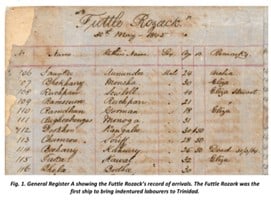
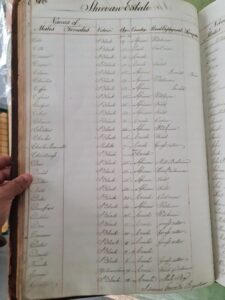
  • Indentureship records on disembarkation document the names of populations transported on those ships. This appears to be a small distinction, nonetheless please note that this is a luxury not afforded to trafficked African populations. Any names that were carried across from the Middle Passage were first names alone – with completely different spellings – or none at all. Colonial names were ascribed to all forms of ‘property’ from the Middle Passage, more-than-human and human. The registers of enslaved persons [see below images, with captions] illustrate the markers of commodity as opposed to the markers of relative humanity in the shipping records of South Asian populations where names, fathers’ names can be read.
    • From this we can further understand that the dehumanisation of African populations under chattel enslavement was unique. The racial, extractive processes that emerged from these genocidal traumas were modelled onto populations not White, Western, Christian, ‘Man’…as defined by Euro-Western ideologies into harmful systems operating today. Nonetheless, the mass ethnic cleansing of First People indigenous civilisations and genocidal institution of chattel enslavement and transatlantic trafficking remain crucially and distinctly defining.
  • The differentially forced, coerced, voluntary…migratory patterns that define Trinidad under colonisation from its sighting in 1498 speak to the function of Empire between the so-called ‘Global North’ and so-called ‘Global South’ today: migration controlled, regulated by neo-colonial powers for the purpose of extraction remain within the interests and mainstream approval of a ‘Global North’ ideology. When this is not the case, borders are reinforced and policing measures appear to be strengthened.xxxv
  • The property measures that followed Emancipation and Apprenticeship remain a defining point of the Plantation system as through line and foundation of contemporary socio-political infrastructure and civic cohabitation in Trinidad.
  • As the development of Tobago became fiscally and economically annexed to the sayso of Trinidad’s colonial administration in the latter 19th century, the foundations of the Plantation system became concentrated in Tobago quite into the 20thxxxvi Communities in living memory recall working on estates and organising local agriculture according to a system stemming from the Plantation model: provision-grounds.xxxvii
  • The depth to which the Plantation system can be understood and visible in the experience and realities of Tobagonian communities today runs deep, and is largely informed by its annexation as ward to Trinidad.xxxviii
[Image[NG2.1] {left] and caption sourced from the National Archives of Trinidad and Tobago]
[Image {right}: Slave Registers: Tobago: Plantation Slaves. Indexed, reference T71/481 held by the National Archives in Kew UK accessed by NTG March 26th 2025]

This brief focus on the histories of Trinidad and Tobago does not by far encapsulate the entire complexity of my twin island republic. What I hope to have briefly engaged with, is the distinct paths that both islands have confronted in their being made and making themselves as countries. While legally, politically, fiscally Tobago and Trinidad are one state one nation, the reality of its legal status appears to have a more neo-colonial character in the allowance Tobago is annually distributed by central government, the restriction on natural resources and minerals on the shores and in the waters of Tobago that prevent wealthy local industry from developing beside agriculture and fisheries and pushes Tobago further in the monoculture of tourism as the new plantations according to Keston K Perry’s analysisxxxix…among several other cracks that demonstrate something very clearly: both Trinidad and Tobago were subjected to the 1888-98 annexation in profoundly transformative ways by an infrastructure driven by generating waste for profit that festered beyond independence. The question still remains, of what to do with the lingering rot of colonisation inherited and at times reproduced by now independent institutions and governance in ways that are attentive and informed of Lloyd Best’s observation of our ‘three halves’. The ways in which the tenets and violence of Empire and anti-black racism continue in our own government and policy remain glaring, and to a great extent increasing. A self-repair must clearly be developed alongside an ongoing movement for repair from the bodies that stand on wealth extracted in deeply traumatic violences. In Trinbago today, our cultural expressions borne from resistance, grassroots movements and collectives are confronting these realities guided by some intent of community care and growth.

i    Oral history received by NTG.

ii Archibald, D. (1987) Tobago ‘melancholy isle’. Vol.1, 1498-1771. Port-of-Spain: Westindiana, Woodcock, H.I. (1867) A history of tobago. Ilford: Frank Cass.

iii See previous reference

iv Honychurch, L. (2025) Resistance, Refuge, Revival: The Indigenous Kalinagos of Dominica. Papillote Press.

v See previous reference

vi Woodcock, A History of Tobago

vii ] Honychurch, Resistance, Refuge, Revival

viii Craig-James, S.E. (2008) The Changing Society of Tobago, 1838-1938: A fractured whole. vol. 1 1838-1900 Susan E. Craig-James. Aroma Trinidad and Tobago: Cornerstone.

ix Woodcock, A History of Tobago

x See previous reference

xi Craig-James, The Changing Society of Tobago,

xii See previous reference

xiii See previous reference

xiv The use of ‘top side’, ‘low side’, or ‘windward’, ‘lowlands’, or ‘east’, to describe the different parts of Tobago (especially the eastern half of the island) seems to vary according to several factors. ‘east’ is common use, although oral history testifies to the use of ‘windward’/’lowland’, where Tobago historian Craig-James uses ‘top side/low side’. I will use these terms interchangeably while I build an understanding of the context behind the choices in using one over the other. But these terms refer to the same separation of space in Tobago. See previous reference

xv Craig-James, The Changing Society of Tobago,

xvi See previous reference

xvii Craig-James, The Changing Society of Tobago

xviii See previous reference

xix Higman, B.W. (1995) Slave populations of the British caribbean 1807-1834. Mona, Kingston: The Press, University of the West Indies.

xx See previous reference

xxi See previous reference

xxii Oral history received by NTG, Craig-James, The Changing Society of Tobago,

xxiii See previous reference

xxivSlave Voyages Database

xxv Honychurch, Resistance, Refuge, Revival

xxvi Brereton, B. (1989) A history of modern trinidad: 1783-1962. Oxford: Heinemann.

xxvii See previous reference

xxviiiSee previous reference

xxix See previous reference

xxx Best, L. (1997) ‘Independent thought and caribbean freedom: Thirty Years Later’, Caribbean Quarterly, 43(1–2), pp. 16–24. doi:10.1080/00086495.1997.11829558.

xxxi Manjapra, K. (2023) Black ghost of empire: The long death of slavery and the failure of emancipation. New York: Scribner.

xxxii Brereton , A History of Modern Trinidad

xxxiii Oral history received by NTG, Craig-James, The Changing Society of Tobago,

xxxiiv Best ‘Independent Thought and Caribbean freedom’

xxxv Bradley G.M and De Norton ha L (2022), Against borders: The case for abolition, London: Verso

xxxxvi Oral history received by NTG, Craig-James, The Changing Society of Tobago,

xxxvii See previous reference

xxxviii See previous reference

xxxix Perry, K.K. (2024) ‘Unsettling the plantation “babylon” system’, The CLR James Journal, 30(1), pp. 249–276. doi:10.5840/clrjames202525124.

Sign In Solidarity

Join the movement calling on the UK and other European governments to formally apologise for historic crimes and commit to reparatory justice.