
“Our identity is our greatest strength”: Building from the ground up in Guyana
22nd April 2026
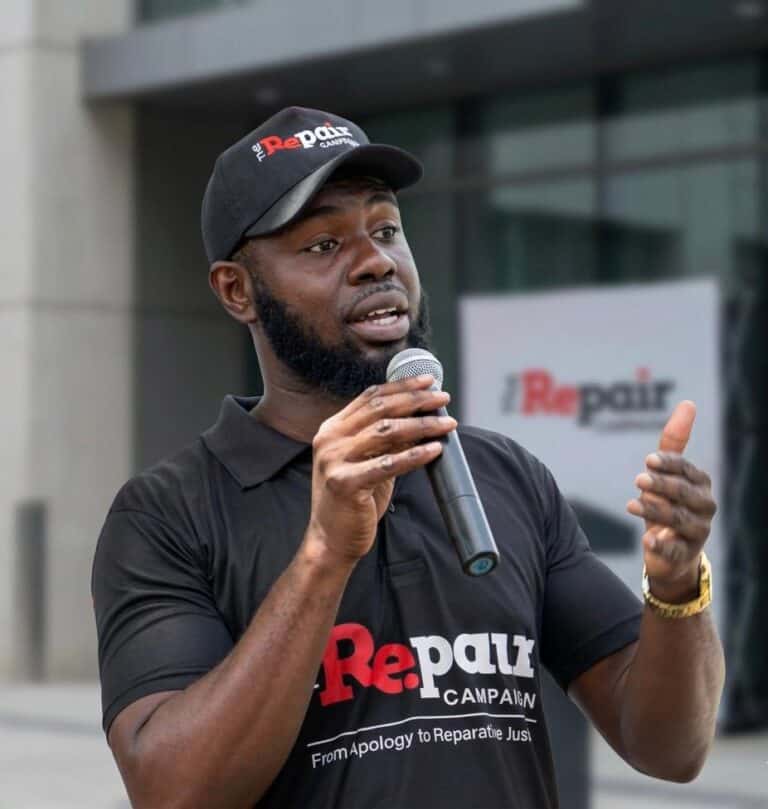
The Repair Campaign spoke to IKEMBA’s President and Community Organiser with The Repair Campaign Kibwe Copeland about community work towards repair in Guyana.
Could you introduce yourself and your work?
My name is Kibwe Copeland, Guyana’s community organiser for The Repair Campaign a born and proud Guyanese, whose life has been shaped by the intersection of public service, community empowerment, and the pursuit of justice. For over 16 years, I have navigated the political landscape, serving at the regional Democratic level and presently as a Councillor for the capital city at the municipal level. Yet, my work extends far beyond the halls of governance. As the founder of Clear Path, I focus on youth self-realization; as Chairman of the Forbes Burnham Foundation, I honor the legacy of our first Executive President; and as President of IKEMBA, the Caribbean’s first youth reparations organization, I am dedicated to the liberation of our collective future. Beyond the titles of activist and businessman, I am a father, a poet, and a lover of the arts, driven by the belief that our identity is our greatest strength.
Could you speak to the significance of Guyana’s histories in ongoing work towards reparatory justice?
Guyana’s history is not merely a chronicle of the past; it is the very bedrock of the Caribbean movement for reparatory justice. Our ancestors’ resistance during the 1834–1838 “Apprenticeship” struggle was the psychological catalyst for true freedom, proving that Guyanese people have never accepted the rebranding of forced labor. This spirit birthed the 1839 Village Movement, a monumental act of self-reparation. By pooling resources to purchase plantations like Victoria and Northbrook, our forebears created an independent economic base, a historical blueprint for community-led development that we seek to replicate today.
This legacy of defiance has evolved into modern institutional leadership. Guyana was a central pillar in the 2013 establishment of the CARICOM Reparations Commission and the subsequent 2014 Adoption of the 10-Point Plan. We have witnessed historic milestones on our soil, such as the 2023 Gladstone Family apology at the University of Guyana, a rare moment where descendants of those who profited from “crimes against humanity” returned to the site of the extraction to pledge support. On the global stage, Guyana’s voice at the UN Permanent Forum over the years and recently in Geneva has been clear: we are now in a “decade of delivery,” demanding that international apologies transition into measurable financial and developmental results.
The economic evidence for our claim is undeniable. As the former “Sugar King” of the British Empire, the wealth extracted from Demerara, Essequibo, and Berbice built the modern infrastructure of Britain, leaving us to navigate post-independence challenges. Our movement is given “intellectual teeth” by Guyanese scholars like Dr. Walter Rodney, whose work remains the definitive analysis of how wealth extraction continues to impact our economy today. Through the Guyana Reparations Committee, the youth-led advocacy of IKEMBA, and the strategic grassroots mobilization of the Repair Campaign, we are turning these academic and historical truths into a formidable force for change.
What motivates you in the ongoing regional movement for repair?
Looking forward, I envision a movement that is massively united and impossible to ignore. I seek a movement that breathes in the halls of academia, speaks in the chambers of law, and pulses at the grassroots level. We need a campaign that permeates our school curricula and inspires our creative artists to shake the foundations of systemic oppression.
True reparations must do more than offer hope; they must liberate the mind, restore dignity, and build pride within the Afro-centric community. Most successful movements are built from the ground up. If we are to force the world to the table of mitigation, the grassroots must not just be involved, they must be the frontrunners.
Through continuous community organizing and empowerment, we will transform the “Echo of the Drum” into a roar for justice that can no longer be silenced.