
No sideshows
7th May 2026
By Jerome Williams from Jamaicaobserver.com
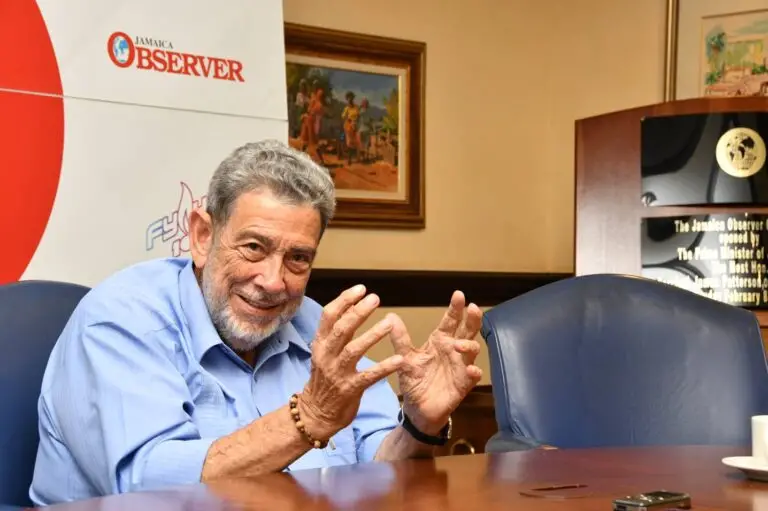
DECLARING that the Caribbean’s fight for reparation must not “fall prey to distractions and sideshows”, former St Vincent and the Grenadines Prime Minister Dr Ralph Gonsalves has dismissed arguments about African involvement in slavery, labelling them as attempts to divert attention from the role European states played in slavery.
He also argued that references to British aid and development support for the Caribbean amounted to “minuscule support” compared to the vast wealth extracted from the region through slavery.
“As an educator, I see the arts as one of the most powerful ways to reach people,” Gonzales said. “‘Repair’ allows us to engage audiences through laughter, music, story and reflection, while still asking serious questions about who we are, what we have inherited, and what reparations can look like for Saint Lucia.”
Christelle Lee, who portrays lead character Ma Ayo, said the production speaks to how history continues to shape everyday life.
Speaking during a Jamaica Observer Press Club on Wednesday, Gonsalves — now senior adviser to the Repair Campaign — said reparation must be viewed not simply as a historical debate, but as both a modern human rights issue and an attempt to address the deep economic and social scars left behind by slavery, colonialism and indigenous genocide.
“The quest for reparation is an international human rights and justice issue,” Gonsalves said, while noting that the United Nations General Assembly in March passed a resolution declaring slavery “the gravest of crimes against humanity”.
“Secondly, the quest for reparation, in a practical sense, is meant to repair the many-sided legacies of underdevelopment, which can be sourced and which are sourced to native genocide and the enslavement of African bodies,” he added.
The Repair Campaign, launched in 2022 by Irish businessman Denis O’Brien, works alongside the Caricom Reparations Commission to push for reparatory justice for Caribbean nations impacted by slavery and colonial exploitation. The campaign supports public advocacy and the development of reparatory justice plans across the region.
Gonsalves argued that critics of reparation often attempt to weaken the movement by steering discussions towards peripheral issues instead of confronting the scale and structure of European involvement in slavery.
He contrasted that with what he described as the systematic role played by European governments and institutions in building and sustaining the transatlantic slave trade.
“The British state says, listen, we are going to go to Africa and we are going ourselves to encourage and induce people to capture others, and we’re going to get induced people themselves to be captured, have forts in which we keep them, and carry them upon ships, and bring them to Jamaica and St Vincent, and sell them to work on plantations,” Gonsalves said.
The veteran Caribbean politician argued that attempts to elevate debates about African complicity are often intended to pull attention away from the core argument for reparations.
“One of the amazing things that persons who don’t want to confront reparation, one of the things is this, they try to keep our minds from the central focus, and take us to sideshows, to distractions, and we have to be careful that we do not fall prey to distractions and sideshows. We have to keep our minds on the main event,” he said.
Gonsalves also took aim at arguments that Britain and other former colonial powers have already compensated the Caribbean through development assistance, trade arrangements and institutional support.
Using the post-World War II banana trade as an example, Gonsalves argued that British support for Caribbean banana exports was driven largely by Britain’s own economic interests rather than altruism. He said Britain expanded trade with the English-speaking Caribbean after the war because it lacked sufficient US dollars to buy bananas from Latin America and Central America, even as American funds were being used to help rebuild Europe, including Germany.
“So they began by giving us a preferential treatment and paying us in pounds stolen to help them to eat bananas because they couldn’t buy it from Latin America and Central America because they didn’t have enough dollars. Eventually, of course, they found that to be a problem because they wanted to enter the single market and economy in Europe and have wanted free trade and we lost our preferences… so it’s true we benefited, but they benefited too,” he explained.
While acknowledging that Caribbean countries benefited from such arrangements, Gonsalves insisted the gains paled in comparison to the wealth extracted during centuries of slavery and colonial rule.
Throughout the discussion, Gonsalves repeatedly linked the reparation movement to present-day development challenges across the Caribbean, arguing that the effects of slavery did not end with Emancipation in the 19th century.
He also pointed to the lack of land ownership, savings, education and generational wealth among formerly enslaved populations after Emancipation, contrasting that reality with the compensation paid to slave owners by the British Government in the 1830s.